Showing posts with label learn woodworking. Show all posts

Friday, October 18, 2019

Kumiko Course

I have been immersing myself into the world of Kumiko over the past year. The intricate patterns or motifs draw you in where the possibilities are endless to the application of the panels in furniture. Another interesting fact is how Kumiko is a traditional Japanese form of craft. To be able to recreate the same motifs that were designed centuries ago intrigued me. At first I thought the delicate technique would be difficult to achieve since the scale of the components in Kumiko is quite small. Kumiko can be intimidating to a novice. Upon further research, I decided to further explore and experiment. As a woodworker, I enjoy challenges and this would be yet another in a long string of challenges over the years. How else do we grow as woodworkers if we don't embrace new skills and techniques.


So one thing led to another and after a few early failures and struggles, I was successful at mastering the Kumiko process of creating intricate lattice-like patterns within a grid or frame. The prerequisite to even beginning Kumiko is to create a couple of guide blocks. The blocks have preset bearing surfaces shaped at various angles. These angles are instrumental to the components within a Kumiko grid. Through the judicious application of a chisel to the miniature Kumiko components, precise angles that interlock the pieces are shaped or beveled. The process is methodical but enjoyable. Small or large grids of components can be created, where time and patience are the only variables.


There are several motifs or patterns to choose from, my focus was the asa-no-ha pattern or hemp leaf pattern. Although Kumiko patterns are considerable, nothing stops one from designing their own patterns. The challenge soon was overcome and the process became second nature to me. The next logical step was to integrate Kumiko into a display cabinet. This worked out surprisingly well!


Most recently, I packaged together several instructional video on how to make Kumiko. The videos show the detail involved and how to create the grids from rough blanks. Other videos focus on creating the small parts within the grid forming the intricate patterns. I also realized that creating the guide blocks is a prerequisite to Kumiko and this step kept many people from experimenting with Kumiko. So other videos describe how to create guide blocks in detail (from rough blanks). Guide Block plans are also included in the Kumiko Course.

Link: Kumiko Course  (WoodSkills)
Link: Kumiko Course  ( Refined Edge Design)

Kumiko Course


Thursday, November 2, 2017

The evolution...

Several years ago, 2006 to be exact, Michael Dresdner contacted me to ask about profiling me in an upcoming Woodworker's Journal online publication. Of course, I jumped at the opportunity to talk about my woodworking and how I got to where I was at the time. I was transitioning from primarily being a box maker to furniture making and the reasons for this shift in direction were discussed in the interview.


Jewelry Box Build

In that period, I had completed a series of courses at a high-end furniture making school and began to use hand tools more in my work. I recall that the year 2006 was an important juncture in my woodworking. I had embraced the Krenov philosophy and his methods of work. Reading and attending the fine furniture making school inspired me to increase the complexity and scale of my woodworking. I also learned to slow down my woodworking and focus instead on each and every piece rather than applying myself to creating in batch mode ( multiples). So my direction changed dramatically in the years 2006-2008 to where I now design + build one-off furniture pieces exclusively.

The most important takeaway from the interview would likely be the last line: “If you are tired of your day job,” Pirollo advises, “do what I did. Pursue your passion instead.” To this day, I completely believe in this quote. It is never to early to pursue your passion. Get a head start, so if unforeseen circumstances affect your livelihood (career), you will be prepared.  Early on my hi-tech career, I pursued many woodworking courses at the college level, set up my own workshops and struggled and worked at learning the woodworking trade. After experiencing a total of 3 downsizings, I gave up on my hi-tech career and moved on to a career in woodworking. This had been my Plan B all along 😉 The important part is that I was well prepared to launch a second career. You never know where fate will lead you!

I'll let you read the article.
Norman Pirollo: The Refined Edge of White Mountain


Saturday, October 14, 2017

Cabinet Build Class

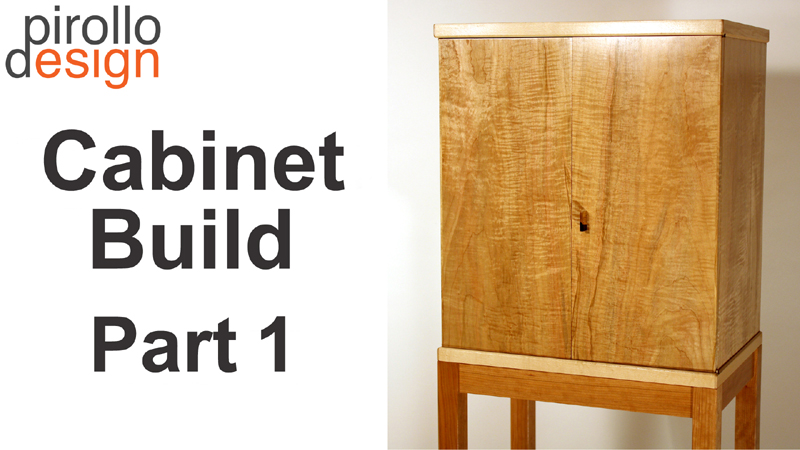
I have recently compiled a series of 16 videos into an online class. The subject was a recent display cabinet build. The design and build of the striking Krenov-inspired display cabinet seen below is discussed and demonstrated. The contemporary styled display cabinet features veneered sides and doors. The veneers selected are highly figured although they can be substituted with alternative veneers. The frame and panel back adheres to the Krenov principle of properly finishing the back of the cabinet. James Krenov is widely known for his classic cabinets on stand as well as the incredible attention to detail he brought to furniture making. He also brought a unique philosophy and vision to furniture making of which I heed and practice. A large part of this veneered display cabinet has been created using an assortment of hand tools although some machinery is used in the initial wood preparation stage. Follow me as I describe the steps involved in creating a masterpiece veneered cabinet on stand.


The following topics are covered in detail in this 16 part design and build class:
  1. Inspiration and design of the display cabinet
  2. An overview discussing components of the cabinet
  3. Wood selection and resawing veneers used in cabinet
  4. The advantages of using veneers over solid wood
  5. Detailed information on creating and using resawn veneers
  6. The process of applying veneers to the sides and doors
  7. Implementing bake-ins to create panels with hardwood edges
  8. Hardwood edging and the veneer press
  9. The veneer press and joinery used in the cabinet
  10. Card scrapers and the use of a shop-made drilling guide
  11. Dowel drilling guide in-depth
  12. The case construction process
  13. Frame and panel construction of the back panel
  14. Back panel detail and installation
  15. Final case assembly of the display cabinet
  16. Installation process of knife hinges for the doors
Each video segment addresses one aspect of the cabinet build. The design process as well as the methodology behind the build are addresses. This is not simply a class on how to build a cabinet on stand. The class will inform you of a similar design process that James Krenov used in his own work. Since I am an ardent follower of James Krenov, the practices I use in this cabinet build closely follow those of James Krenov. Discussions and demonstrations describe how the design of this display cabinet originated and the design considerations in its build. Information on wood selection and preparation as well as the joinery used in this cabinet is covered in detail. Tips and techniques acquired over several years of creating this style of cabinet are shared in this class. The process of creating and applying veneers is covered as well as information on the installation of knife hinges. More info in the Tutorials section of my web site.


Wednesday, October 11, 2017

Furniture Design Course

In this new course, I cover the furniture design topic. This is a topic near and dear to me as I believe that good design is essential in a quality furniture piece. Good design also minimizes wasted resources and provides a furniture maker with essential feedback and pause when creating furniture. Loosely translated, the design process keeps the maker from rushing into a potentially flawed furniture design. The checks and balances give pause to the process as well as streamlining the build. Developing your own style and furniture aesthetic is also covered. Selecting the right woods for your furniture design is critical in determining the appeal of the final furniture piece.

As with most woodworkers, I was anxious to build furniture early on. With the passage of time and several furniture projects completed, the anxiety of simply creating work had passed. It was far more important to create a well-designed and striking piece of furniture. So I delved into furniture design, studied with some renown furniture makers, and used this knowledge to establish a furniture design process that works.


Furniture Design Course

In the online furniture design course you will learn the skills necessary to design and create your own unique furniture. Learn to develop your own style of furniture and aesthetic. Over 2 hours in total. Course features videos on these topics:
  1. Furniture design overview, the history of furniture design
  2. Becoming familiar with the furniture design process
  3. Understand design process, bring your furniture designs to next level
  4. How to select wood for a furniture design
  5. Use of mockups and prototypes to develop a furniture design
  6. In-depth use of mockups to develop a furniture design
  7. Determining a furniture style for your own furniture designs
  8. Selecting a furniture style and aesthetic
  9. Developing a furniture design
  10. Getting the proportions right in a furniture design
  11. Using the dynamic design process in a furniture design
  12. Use of maquettes and prototypes in a furniture design
  13. Use of templates and CAD when designing your furniture

Tuesday, June 28, 2016

New web site...

After 9 years of blogging here, I have a new place for blogging. Along with a new web site.. WoodSkills , a new blog is now integrated into this new site.  The new site and blog will allow my readers to view my blog directly at the web site. I've had to replace the existing WoodSkills web site with a new, up to date one mostly due to new web site conventions and standards. I also decided to continue blogging here at The Refined Edge for the next while.

With the advent of mobile phones and tablets, it became critical to have a web site which rendered well on the different devices. The Internet was the wild west many years ago, web sites would render well on one browser and fail miserably on others. Today, technology has evolved to where modern web sites need to render not only on the desktop but also on mobile devices and tablets.

Other news. I have had to undergo some major surgery recently and am currently on the mend. The post-surgery recovery period limits what I can do, so not much in the way of physical activity for a few weeks. I am planning to get back into the shop later this summer, (mid-August). At this time, activities such as hand-planing are restricted as well as lifting objects. So this effectively rules out woodworking for a few weeks :( This is me on the day of discharge from the hospital. I'm up and about now and improving every day.


Please visit the new WoodSkills site for new blog posts and other information, offerings.

Saturday, March 26, 2016

New, updated woodworking course...


What I've been up to. So I decided to update the Woodworking Course I have been marketing. I hunkered down and added new graphics and images to the course. It is now much more interesting to watch and hopefully a great learning experience for someone wanting to learn woodworking. The comprehensive course content is similar to what it was, the lectures are all there although a couple of lengthier lectures ( bandsaw and veneering) have been broken up into 2 individual lectures each. In the process there is a new Course Overview that I will include here. This was a huge amount of work and I broke it up into manageable pieces over a period of weeks. I enjoyed the process and it re-acquainted me with some aspects of woodworking I had been neglecting! Available through: WoodSkills