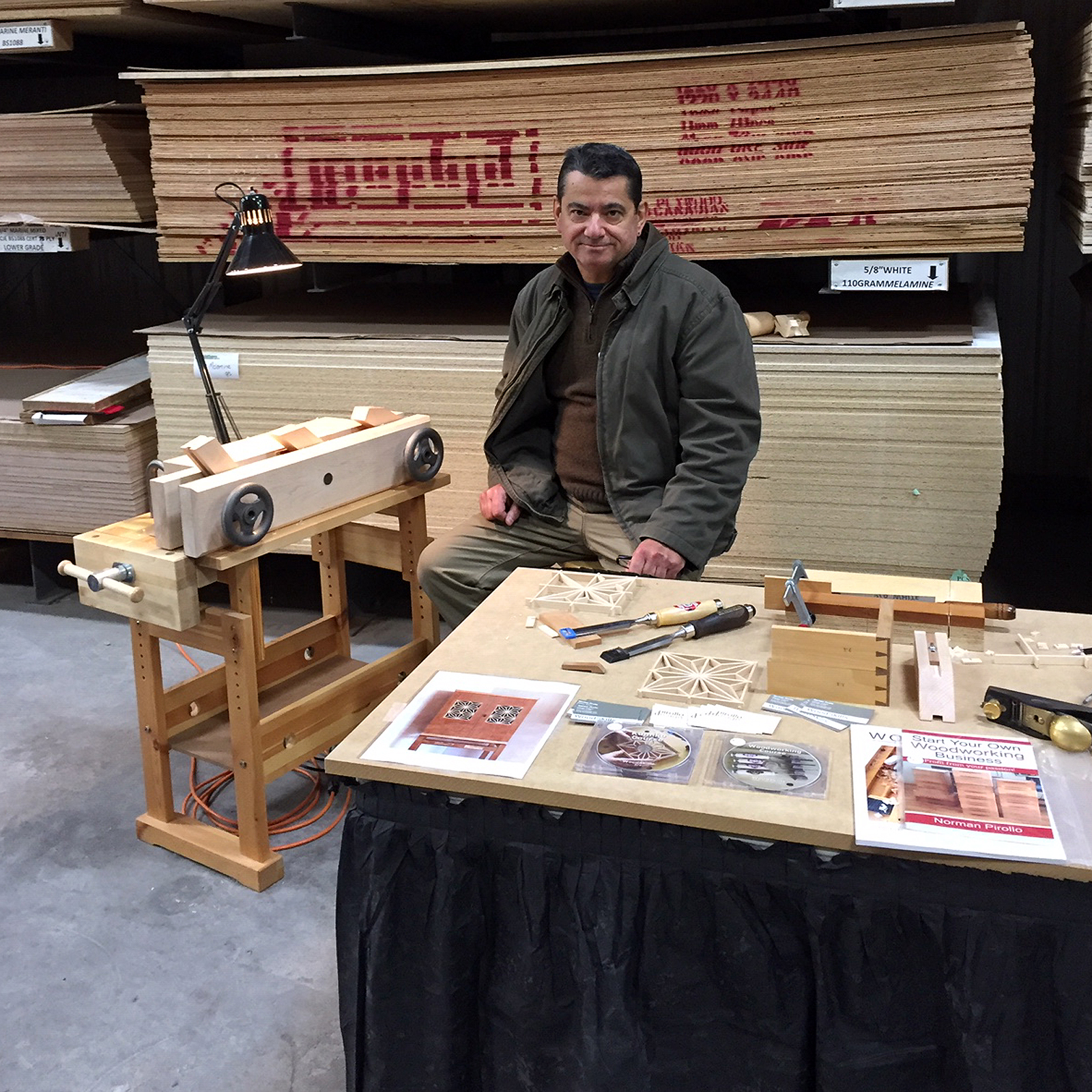
I came across an opportunity to both demonstrate and talk about the traditional Japanese craft of Kumiko at an annual woodworking event. In discussion with a local wood supplier and mill (Wood Source Ottawa, Ont.), they mentioned their upcoming annual open house and how they encouraged local vendors and artisans to participate. I quickly signed up at the opportunity to present and share my passion of Kumiko. Proceeds from the open house silent auction also went to a good cause, so this became another motivation for me to participate. I truly enjoy discussing woodworking and love to engage with people and hopefully motivate them to either start or continue to pursue woodworking.
I had several days to prepare and had sufficient time to create enough Kumiko components to last through the open house. The opportunity also challenged me to devise an innovative way to hold Kumiko guide blocks without having to continually unclamp and clamp the critical guide blocks to a vise. I was able to enlist my Moxon vise along with a small workbench to perform this. The opportunity also provided me the impetus to market a Kumiko Course I had been working on. I could offer the video-based course at the open house! So this all came together and I enjoyed two days at the open house engaging with people and introducing them to the centuries-old traditional Japanese craft of Kumiko.
At first glance, people would be in awe at the small scale of components in Kumiko. Their first reaction was how intimidating and difficult it was to tackle. After engaging and demonstrating the ease of forming and shaping the small interlocking parts, their fears vanished. Often, people need to have a technique presented in a live setting to grasp its intricacies. I get this and can easily relate to this form of learning and visualization. Techniques of safely using a wide chisel to pare wood were also demonstrated, being the core of Kumiko component creation.
I enjoyed the experience and in the process made a few local contacts. Hopefully, I have encouraged a few people to tackle Kumiko and woodworking in general. Working in a solitary studio environment often keeps me from interacting with like-minded people that share a common interest in woodworking. People enjoy sharing their passion and the timing of this open house was ideal since I was between projects and needed a break from my furniture design + making.
Link to Kumiko Course
Showing posts with label kumiko class. Show all posts
Tuesday, November 12, 2019
Friday, October 18, 2019
Kumiko Course
I have been immersing myself into the world of Kumiko over the past year. The intricate patterns or motifs draw you in where the possibilities are endless to the application of the panels in furniture. Another interesting fact is how Kumiko is a traditional Japanese form of craft. To be able to recreate the same motifs that were designed centuries ago intrigued me. At first I thought the delicate technique would be difficult to achieve since the scale of the components in Kumiko is quite small. Kumiko can be intimidating to a novice. Upon further research, I decided to further explore and experiment. As a woodworker, I enjoy challenges and this would be yet another in a long string of challenges over the years. How else do we grow as woodworkers if we don't embrace new skills and techniques.
So one thing led to another and after a few early failures and struggles, I was successful at mastering the Kumiko process of creating intricate lattice-like patterns within a grid or frame. The prerequisite to even beginning Kumiko is to create a couple of guide blocks. The blocks have preset bearing surfaces shaped at various angles. These angles are instrumental to the components within a Kumiko grid. Through the judicious application of a chisel to the miniature Kumiko components, precise angles that interlock the pieces are shaped or beveled. The process is methodical but enjoyable. Small or large grids of components can be created, where time and patience are the only variables.
There are several motifs or patterns to choose from, my focus was the asa-no-ha pattern or hemp leaf pattern. Although Kumiko patterns are considerable, nothing stops one from designing their own patterns. The challenge soon was overcome and the process became second nature to me. The next logical step was to integrate Kumiko into a display cabinet. This worked out surprisingly well!
Most recently, I packaged together several instructional video on how to make Kumiko. The videos show the detail involved and how to create the grids from rough blanks. Other videos focus on creating the small parts within the grid forming the intricate patterns. I also realized that creating the guide blocks is a prerequisite to Kumiko and this step kept many people from experimenting with Kumiko. So other videos describe how to create guide blocks in detail (from rough blanks). Guide Block plans are also included in the Kumiko Course.
Link: Kumiko Course (WoodSkills)
Link: Kumiko Course ( Refined Edge Design)

So one thing led to another and after a few early failures and struggles, I was successful at mastering the Kumiko process of creating intricate lattice-like patterns within a grid or frame. The prerequisite to even beginning Kumiko is to create a couple of guide blocks. The blocks have preset bearing surfaces shaped at various angles. These angles are instrumental to the components within a Kumiko grid. Through the judicious application of a chisel to the miniature Kumiko components, precise angles that interlock the pieces are shaped or beveled. The process is methodical but enjoyable. Small or large grids of components can be created, where time and patience are the only variables.
There are several motifs or patterns to choose from, my focus was the asa-no-ha pattern or hemp leaf pattern. Although Kumiko patterns are considerable, nothing stops one from designing their own patterns. The challenge soon was overcome and the process became second nature to me. The next logical step was to integrate Kumiko into a display cabinet. This worked out surprisingly well!
Most recently, I packaged together several instructional video on how to make Kumiko. The videos show the detail involved and how to create the grids from rough blanks. Other videos focus on creating the small parts within the grid forming the intricate patterns. I also realized that creating the guide blocks is a prerequisite to Kumiko and this step kept many people from experimenting with Kumiko. So other videos describe how to create guide blocks in detail (from rough blanks). Guide Block plans are also included in the Kumiko Course.
Link: Kumiko Course (WoodSkills)
Link: Kumiko Course ( Refined Edge Design)

Subscribe to:
Posts (Atom)


